Ruth's pill
I Am LegendRuth's pill is both a medical device and a compressed revelation about the future of humanity. Left first as evidence and later pressed into Robert Neville's hand before his execution, it shows that the infected have learned to live with the germ, that their society is reorganizing itself, and that Robert's supposedly rational understanding of vampirism has become obsolete. Its physical smallness contrasts with its enormous consequences: the pill changes his interpretation of Ruth, the disease, the new society, and his own place within history.
Definition and Composition
Ruth's pill is a treatment developed by the emerging vampire society. Ruth explains that she had carried the pills in a belt around her waist and taken them throughout her stay in Robert Neville's house. The treatment combines defebrinated blood with an unidentified drug. The blood feeds the germs, while the drug prevents their multiplication, allowing infected people to survive without dying from the disease and gradually to reestablish social life.
The pill therefore does not eliminate the germ. Its operation is based on controlled coexistence with infection. Ruth states that the new people can now live with the germ and can tolerate short periods in sunlight, a change that directly contradicts Robert's assumption that the older signs of vampirism still define every infected person. The pill is consequently evidence of biological adaptation as well as a practical remedy.
Revelation and Material Evidence
Ruth leaves one pill behind because she knows Robert may not believe her account. She recognizes that a verbal explanation alone cannot overcome his suspicion, so the object functions as a material proof of her claims. Its presence confirms that her apparent immunity and her ability to remain in sunlight were not simply tricks of appearance. The pill makes the new physiology tangible, turning an abstract report about mutation into something Robert can examine and interpret.
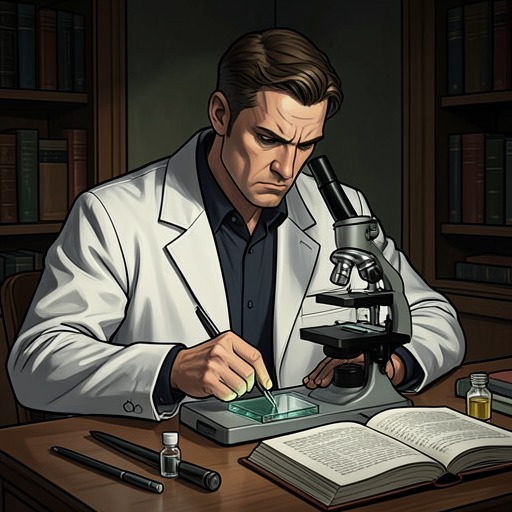
Robert's response to the pill leads him back to a basic scientific principle: bacteria can mutate. That realization changes his entire understanding of the catastrophe. He had spent years studying vampirism through the evidence available to him, but he had treated the condition as more stable than it was. The pill exposes the limitation of his conclusions. The disease has not merely produced victims; it has produced variations capable of adapting, surviving, and organizing themselves into a new society.
Ruth's Final Gift
The pill returns at the end of Robert Neville's life in a more intimate and urgent form. After the new society captures him, Robert is wounded and told by Ruth that they intend to execute him. The people outside have been waiting through the night, terrified of him and determined to kill him even though he is already injured. Ruth reaches beneath her brassiere, takes out a tiny packet, and presses it into his right palm.
She tells him to take the pills soon and turns away, leaving him with the object and the knowledge that she cannot stop the crowd. Her gesture is therefore simultaneously an act of care, an admission of helplessness, and a final continuation of the warning she had previously given him. Robert understands that he cannot fight so many people. When Ruth locks the door behind her, the pills remain as the only control he retains over the manner of his death.
Function in Robert Neville's Ending
Robert swallows the pills while looking at the new people of the earth. He has realized that they regard him as a terrible scourge, a figure more frightening to them than the disease itself. The pills make possible an ending without the public butchery the crowd intends: instead of allowing himself to be destroyed violently before their eyes, he chooses the lethargy produced by the drug.
The object also completes the reversal of perspective that governs the ending. Robert had defined the infected as monsters and himself as the surviving norm. The pill proves that the infected have become the historical majority, while Robert's resistance has become the anomalous threat. As he takes it, he sees that he does not belong to the new society and recognizes that he has become, in its collective imagination, an object of fear and superstition. Ruth's pill thus enables his death while also giving him the clearest understanding of what that death means.
Symbolic and Narrative Significance
Ruth's pill gathers the novel's conflict between science, bodily change, and social judgment into a single object. It is not a magical cure or a return to an earlier human order. It is a technical compromise with infection, an intervention that allows the new population to transform the conditions of life. Its chemistry is partly unknown even to Ruth, underscoring that adaptation has outrun Robert's knowledge.
The pill also reverses the usual relation between object and owner. At first, Robert treats it as evidence that can be tested against his scientific reasoning. At the end, it becomes an instrument he must use personally, and its meaning depends on his acceptance of the new society's reality. In swallowing it, he accepts that the world has changed beyond the categories by which he lived. His final recognition of a “full circle” links the pill to the birth of a new legend: the old vampires feared daylight and the old human survivor feared the new people, but each side becomes monstrous from the other's perspective. Ruth's pill is the small material fact that makes that historical reversal possible.